Beyond the Victim: Migrant Agency and the Making of Modern Punjab (1947-1960)
DOI:
https://doi.org/10.65463/44Keywords:
Migration, Partition, Punjab, Agency, CitizenshipAbstract
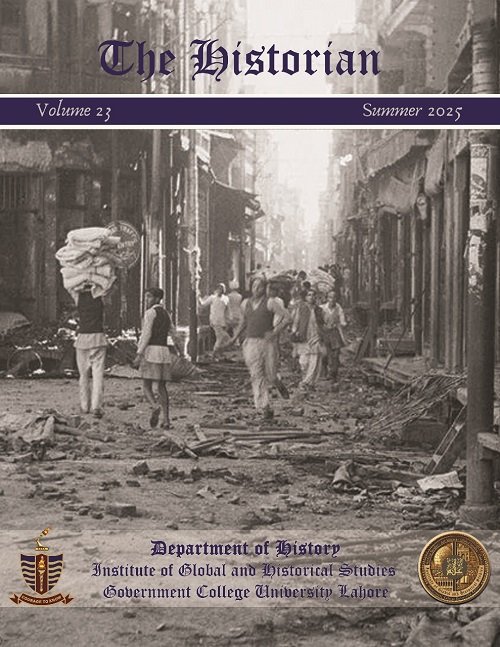
The 1947 Partition of British India is overwhelmingly remembered as a moment of profound trauma, communal violence, and mass displacement. This narrative, while historically vital, often frames the millions who crossed the borders as passive victims of circumstance and state failure. I propose a necessary re-evaluation of this perspective. This essay analyses the aftermath of Partition in Punjab from 1947 to 1960, not as a story of passive suffering, but as a complex process of transition in which migrants acted as central agents in their own resettlement and in the foundational fabric of the new Pakistani state. I argue that these individuals, far from being mere recipients of aid, actively navigated, negotiated with, and even resisted state policies to reclaim their lives. My analysis traces their journey from the chaos of refugee camps and the crisis of evacuee property to their substantive integration into the economic, social, and political life of West Punjab. By examining state rehabilitation schemes, agricultural policies, and early political mobilization, I demonstrate that migrants were instrumental in rebuilding Punjab's shattered economy and shaping the very nature of citizenship and politics in early Pakistan. This study, therefore, reframes the migrant experience as one of resilience, adaptation, and active participation in state-building.
Downloads
Downloads
Published
Issue
Section
License
Copyright (c) 2025 UMER WAHEED (Author)

This work is licensed under a Creative Commons Attribution-NonCommercial-NoDerivatives 4.0 International License.